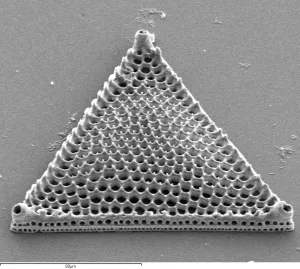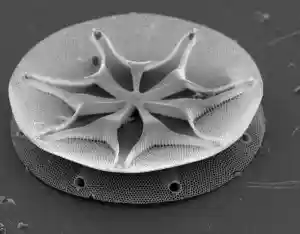
Centric Diatom (Mary Ann Tiffany)
On Thursday last week Dick was giving a seminar to a group of Russian scientists in Irkutsk on Lake Baikal via Skype. The people there were all familiar with diatoms so before I report on his presentation, I thought I would give some background on diatoms.
Diatoms are unicellular, eukaryotic, photosynthetic algae that are found in aquatic environments. Diatoms have enormous ecological importance on this planet and display a diversity of patterns and structures at the nano- to millimetre scale.
Diatoms are microscopic (2 µm to 4 mm), and species are classified mostly by the shapes and patterns of their hard silica parts. There are 250 living diatom genera with more than 200 000 estimated species classified by their unique morphologies. The silica (glass) shell, or ‘frustule’, consists of two overlapping valves joined with silica girdle bands, much like a Petri dish. There are two major groups that are separated based on valve symmetry. The pennate diatoms are elongate, usually with bilateral symmetry. Centric diatoms have radial symmetry. The pennates are placed into two classes depending on whether or not they have slits in the valves called raphes. These slits are involved in gliding motility. Dick has been studying diatom motility for most of his adult life and the above is adapted from his review article “The Glass Menagerie: diatoms for novel applications in nanotechnology”
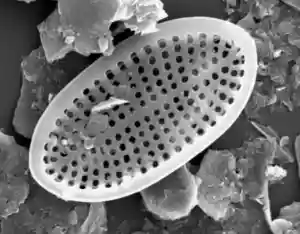
Pennate diatom without a raphe (Mary Ann Tiffany)
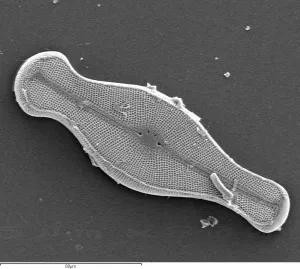
Pennate diatom with two raphe slits (Mary Ann Tiffany)
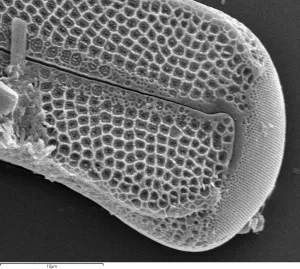
Close up of a raphe, which goes clear through the shell (Mary Ann Tiffany)
Gardeners are familiar diatomaceous earth which is mostly diatom shells. You are most likely familiar with diatoms for their killer aspect. Diatoms are what gives rocks in running water that lovely slick coating that makes falling in rivers and creeks so easy. During a trip to Yellowstone, we saw a man wading across the rocky bottom of a fast moving small river about 10 meters back from the edge of a five story waterfall. We left before we were forced to to witness the diatoms killing this poor fellow in front of his wife and children. We later reported this to a ranger who sighed deeply and said “Yellowstone is the Olympics of the Darwin Awards. Too bad this guy has already reproduced.”
You can read more about diatoms in a great Wikipedia article . In the meantime here are a couple more of Mary Ann Tiffany’s wonderful images which she has so graciously given us permission to share. Diatoms Are Forever is the title of a book we are working on with a few diatomist colleagues.