
There are several models of how diatom motility works:
Snail-like movement (proposed by Christian Gottfried Ehrenberg in 1838)
Jet engine like motion using a form of jet propulsion (proposed by Carl von Nägeli in 1849, modified by C.Th. von Siebold in 1853), long before the jet engine was invented!
Rowing model (proposed by J. Hogg in 1855)
Rocket ship model: O. Bütschli (1892) and Robert Lauterborn (1896) proposed that a sticky jelly-like substance, extruded quickly in fine threads at the nodules of the raphes, propels the cells by mechanical recoil.
Extroproplasm streaming model think of a tank tread (proposed by Otto Müller in 1893)
And then there is capillarity (Flame of Life) model:
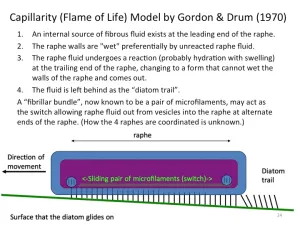
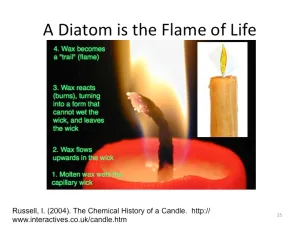
A new competing model by Lesley Edgar and Jeremy Pickett-Heaps (1983) proposes that the raphe fibers are passively carried by myosin motor molecules.
The problem of diatom motility is still unsolved.
Lesley Ann Edgar (1955-2006) analyzed movie films of motile diatoms at 10 frames per second and noted erratic accelerations to 100 µm/sec2 (see Edgar, L.A. (1979). Diatom locomotion: computer assisted analysis of cine film. Br. Phycol . J. 14 , 83-101.)
- “It is possible that such a strand is secreted in short units corresponding to release of individual loads of locomotor material from within cytoplasmic vesicles through the plasmalemma, so that locomotion would occur in a series of steps” (Edgar, L.A. (1979). Diatom locomotion: computer assisted analysis of cine film. Br. Phycol . J. 14 , 83-101.)
Hm….very interesting result. So we (working with Can Sabuncu and Ali Beskok at Southern Methodist University) followed up, and got the same result, even though our camera is nearly 1000 times faster:
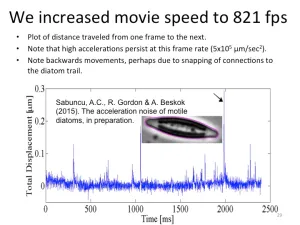
We may be seeing very high speed forward and backwards movement. So maybe the rocket propulsion model is right: strands of mucilage are extruded along the raphe. They hydrate on contact with water exiting the raphe in chemical explosions. These repeated explosions move the diatom along in spurts. The mucilage is left behind as the sticky “diatom trail”. Its elasticity sometimes pulls the diatom backwards as the connection with the trail is stretched and breaks.
Is this correct? We need more research. Our next plan includes computer simulation:

This blog is a summary version of:
History and future of understanding the mechanism of diatom
motility
6TH INTERNATIONAL VERESHCHAGIN
BAIKAL CONFERENCE
AND 4TH BAIKAL SYMPOSIUM ON MICROBIOLOGY (BSM-2015)
MICROORGANISMS AND VIRUSES IN AQUATIC ECOSYSTEMS
September 7-12, 2015
Richard Gordon
Gulf Specimen Aquarium & Marine Laboratory, Panacea, Florida, USA
Ali Beskok & A. Can Sabuncu
Department of Mechanical Engineering
If you would like a copy of the full presentation, please send us a message.
Share this:
